“NEW ART”, THE SOFT-COVER: FUNCTION, FORM & MODERNITY
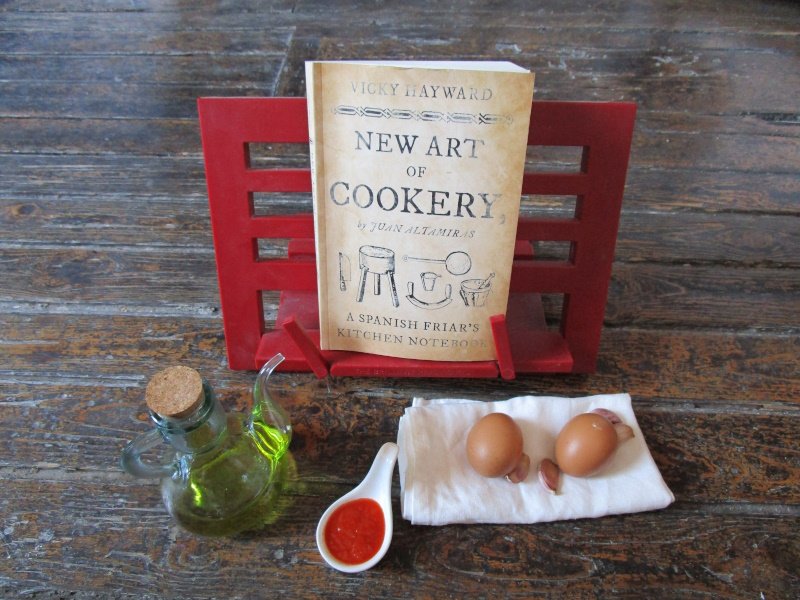
When you hold an 18th-century original of Juan Altamiras’s book in your hand, whichever it may be of the five editions published in his lifetime, it has an immediate power of communication. Simply bound, a little chapbook, octavo in size, nestling in your hand, it is easy to read and carry around, like the early paperbacks of the 1930s and 1940s.
Nothing could be further from today’s garish food porn. Yet clearly, in the 18th century, Altamiras’s writing, which avoided polished smoothness for a joky, intimate directness, to the point, could grab readers, awaken their appetites and get them to work creating in the kitchen.
So clear were Altamiras’s aims and aesthetics, in both his words and the intentions in the silent spaces between the lines, that they shaped the approach to recreate the book. Today, historic cookbooks may be found in many formats: there are facsimiles, beautiful but sometimes inscrutable, or, at the other end of the spectrum, weighty academic volumes with the emotional disconnect needed to establish an analytical discourse. There are also a new generation of digitalised library texts, and there are books looking to style the past as heritage.
Yet Altamiras, I felt, needed something else. The richness of his laconic words, sensual and emotional with flavours and ironies, needed culinary and cultural unpacking that an academic volume, or one that sidelined the cookery, would diminish, stripping away the joky friary intimacy and underplaying his really remarkable kitchen skills. As multidisciplinary research revealed the significance of his words, it grew into narrated history as contextualisation.
So it was, as I translated and experimented with writing form, that I began sewing together the original recipes with home-cooked 21st-century versions and largely historic contextualisation. In this way each recipe reamined independent, as in the original book, and they could run in the same order, reflecting Altamiras’s 18th-century world viewpoint. Yet together, they built into a new whole, at the end of which a glossary of kitchen terms, a double index – general and cookery – and footnotes offered different readerships ways into sampling the text and gave the necessary references for the use of New Art as a history book.
Both the first editions of the book, in English then afterwards in Spanish, were designed to locate an indeterminate past free of today’s concepts of “authenticity”, “heritage”, or “gastronomy”, and its culture wars, concepts unknown to Altamiras and alien to his approach. Rather, as Dr. Christopher Kissane has suggested in his studies of cookery in early modern Europe, we could say that Altamiras was “thinking with food” as he conjured up dishes designed for all five senses and for a vision of a fairer society. And we can also take such an approach.
A final piece of the recreation puzzle fell into place in 2024 when the English edition passed to Bloomsbury Publishing and their editor suggested a paperback edition. By then the project had found many public-facing expressions, such as talks, recreations of historic dishes, workshops, videos, academic essays, conversations, and, of course, the book websites.
Yet the new paperback gives a special sense of satisfaction.
In taking a step back to the original little 1745 chap book, which sold at just a third of the price of glitzier court chefs’ fatter volumes, it can reach a new readership, and, at the same time we have in our hands a book to carry into the kitchen, perhaps, even, on which to leave a personal mark, a thumbprint across time of tomato and orange sauce, hazelnut gravy, honey or quince sauce or his minimalist friary chickpea broth.
❖ If you’d like to read this text in Español, just click on this link!
The richness of Altamiras’s words and food, sensual and emotional with flavours and ironies, needed culinary and cultural unpacking that an academic volume, or one that sidelined the cookery, would diminish.”