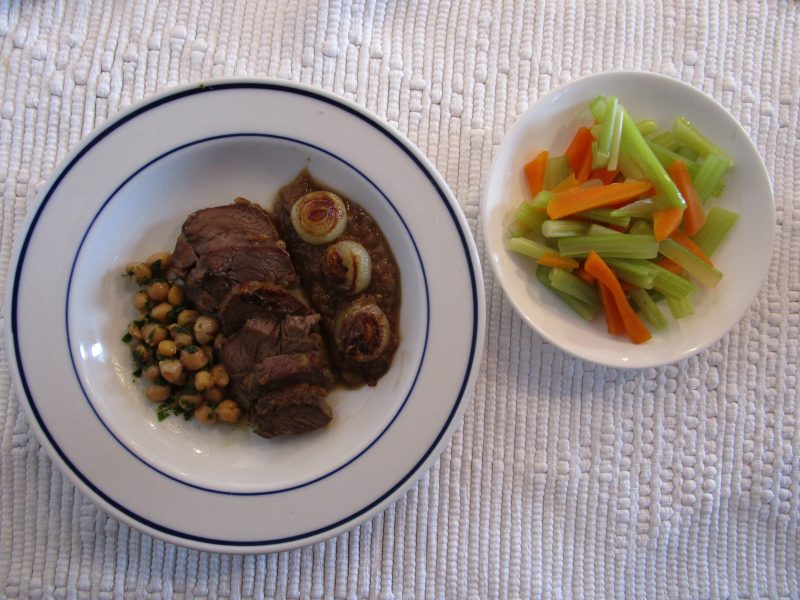
Beef, Veal and their Broths: Yesterday To Tomorrow

For cooks today the recreation of early modern meat dishes brings with it particular challenges and special satisfactions.
The challenges lie in the ingredients. As Peter Hertzmann, cook and food historian, wrote recently in Petits Propos Culinaires, “just pulling a shopping list” from some historic recipes can be hard. This is especially true for meat: the cut and quantity may not be given; nor the butchery, boning and trimming details; let alone the kind of meat. Altamiras often chose not to specify his carne, probably usually hogget or mutton, and he gave no recipes for fresh pork except for one rare seasonal luxury, roast suckling pig (the few adult pigs around then were salted), but he came into his own with beef and pink veal, which Mestre Robert – Ruperto de Nola – had entirely ignored.
Altamiras’s repertoire may owe something to his home-town La Almunia’s cattle-fair and the grazing pastures on the plain and hillside slopes close to San Cristóbal, but archive accounts also reveal calf as the go-to home-fattened livestock for friary feasts elsewhere. In one recipe, for braised steaks, Altamiras lets drop that this may have been a matter of taste, mentioning that between veal and mutton: “veal is the better.” Additionally he would have known that mission cooks in the New World needed these recipes: the Franciscans, rarely and unwillingly large-scale landowners in Spain in fulfilment of their vow of poverty, were already large-scale cattle ranchers in Mexico, Texas and Florida.
Today his nine beef and veal recipes – some for stewing or pot-roasting mixed cuts, and others for preparing today’s neglected ones, like feet, tongue and cheeks – have a new relevance for tomorrow’s kitchens as grass-fed beef farming using low-carbon, sustainable grazing methods goes from strength to strength, especially in dryland areas, taking us back to the kind of mature meat Altamiras knew, to be treated with respect and paid for appropriately. In some cases regional cattle breeds, reared humanely on family farms, are also finding a new future – for example, in five areas in Spain – thanks to revived demand for their premium meat produced with no recourse to industrialised macrofarming, accompanied by an inevitable environmental impact.
Likewise, Altamiras gives a dozen or so soups and rices that come alive when prepared with a good beef or veal stock.
Two of the guest chefs invited to recreate recipes for the book have picked such recipes for their own contemporary versions: Michelin two-starred chef Kiko Moya from the Alicante sierras developed his arròz de grassa with a broth from shin of veal or beef, researched for its texture and flavour, while Madrid-based tapas cook Antonio Amago adapted his family’s recipe for beef cheeks, dating from the 20th-century decades when economic cuts were highly valued.
My own choice among these dishes to discover at home with meat from grass-fed livestock is the pot-roast pink veal shank on the bone flavoured with lemon, aguardiente and cured ham fat. In this recipe the special satisfactions and relevance of researching historic recipes’ culinary detail speak clearly in the delicious eating it gives.
❖ If you’d like to read this text in Español, just click on this link!
See also:
❖ 1 Braised Beef, Ox or Calf Cheeks
❖ 2 Antonio Amago and Vicky Hayward: Carrilleras de ternera (subtitled in English)
Grass-fed beef farming goes from strength to strength as a low-carbon, sustainable form of livestock rearing, and it takes us back to the kind of mature meat Juan Altamiras knew.”